How to fuel a long bike race without bonking
A long bike race lives or dies on fuelling. You can train all winter, peak perfectly, and have the form of your life, but if you bonk at 120 km because you skimped on carbs from kilometre 30, the last hour is going to be miserable. The good news is that fuelling a long ride is mostly a numbers game once you understand what your body actually needs.
This guide is built around a 4 to 6 hour effort, the typical length of a 100 to 200 km race, sportive, or gran fondo. The same principles scale to anything in that range.
Here is the plan, broken down into the four phases that matter: the night before, race morning, on the bike, and recovery.
The night before
Forget the giant pasta party. It looks great on social media but it is not how modern endurance fuelling works.
You want to top up your glycogen stores, not stuff yourself into discomfort. Aim for a meal with around 1 to 1.5 g of carbohydrate per kg of body weight. For a 70 kg rider that is roughly 70 to 100 g of carbs. Rice, pasta, potatoes, bread, any of them work. Pair with a moderate amount of protein and easy-to-digest vegetables. Skip anything heavy on fat or fibre, both slow gastric emptying and can make you feel rough on the start line.
Drink to thirst through the evening, plus an extra glass of water with a pinch of salt. Do not over-hydrate. You will spend half the night in the bathroom and start the morning short on sleep.
Race morning
Three hours before the start, eat a proper breakfast. Three hours is the sweet spot for digestion in most riders. Eat too late and you race with a brick in your stomach. Eat too early and you are already hungry by the gun.
A typical breakfast for a 70 kg rider:
Oats or porridge (60 to 80 g dry weight) with banana and honey
One slice of toast with jam
Black coffee if you train with it
500 ml of fluid, ideally with a pinch of salt
That is roughly 120 to 150 g of carbohydrate. You are loading the liver glycogen tank so it is full by the start.
Thirty minutes before the start, top up with a gel, a small banana, or a handful of dates. Around 30 g of carbs. This is the bridge fuel that gets you to the point where on-bike fuelling kicks in.
On the bike
This is where most amateur cyclists get it wrong. They wait until they feel tired to start eating, by which point they are already behind. The rule is simple: eat early, eat often, do not stop.
Start fuelling within the first 30 minutes of the race. Target 60 to 90 g of carbs per hour for the full duration. For a 5-hour race that is 300 to 450 g of carbs total on the bike. Sounds like a lot. It is, and it takes practice to absorb at that rate, which is why you train your gut in the weeks before.
A practical hourly mix that hits roughly 80 g/h:
One bottle of carb drink (40 to 60 g per bottle)
One gel (20 to 30 g) every 30 to 45 minutes
Optional solid food in the first half, gels and drink in the second half
Solid food is great early. As intensity climbs and you get further into the race, your gut slows down. Most experienced racers shift to liquid and gels in the last 90 minutes.
Electrolytes
For a long race you need sodium, not just water. Aim for 500 to 1,000 mg sodium per hour depending on conditions. Hot day, salty sweater, sweating heavily? Go closer to 1,000 mg. Cool, dry, light sweater? 500 mg is fine.
The easiest way is to mix an electrolyte tab into one of your bottles. Most commercial tabs hit 250 to 500 mg per serving.
What to actually carry
Plan your fuelling stops if it is a sportive with feed stations. If it is a self-supported ride, work out how much you can carry, where you can refill, and where you can buy more if needed. Petrol stations and village shops are your friend.
A rough kit for a 5-hour race:
2 to 3 bottles loaded with carb drink
6 to 8 gels in jersey pockets
1 to 2 small bars or bananas for the first half
An emergency 50 g of carbs (one extra gel, or a bar) you do not plan to eat
Recovery
The race is done. Now what.
The 30-minute "anabolic window" is overhyped, but you still want to start refuelling soon. Within the first hour after finishing:
60 to 80 g of carbs to start glycogen replenishment
20 to 30 g of protein
500 to 750 ml of fluid with sodium
A recovery shake, a bowl of rice with chicken, or a sandwich with a glass of milk all work. The exact food matters less than getting carbs and protein in.
Then have a proper meal within 2 to 3 hours. Whatever you fancy. You have earned it.
What goes wrong, and how to fix it
You start cramping at kilometre 100. Almost always under-sodium, sometimes under-fuelled. Fix it on the bike with an electrolyte tab and a gel. Fix it for next time by getting your sweat test done and bumping sodium intake.
You bonk in the last hour. You either started fuelling too late or did not hit your hourly target. There is no clever rescue here other than slowing down and eating immediately. Prevent it next time by setting a 30-minute timer and eating to the timer, not to hunger.
You feel sick and cannot eat anything. GI distress, usually from going harder than your gut can absorb at, or from too much sugar concentration at once. Switch to dilute fluid for 30 minutes. Slow down. Then resume gels gently.
You finish with carbs still in your pocket. Better than the alternative, but it means you under-fuelled. Look at the data, count what you actually ate, and adjust your hourly target for next time.
Make the plan, follow the plan
Fuelling a long race is not complicated, but it is detailed. The riders who get it right do not improvise on race day. They have a plan, written down, that says "120 g of carbs at breakfast, 80 g/h on the bike, 750 mg sodium per hour, gel every 30 minutes".
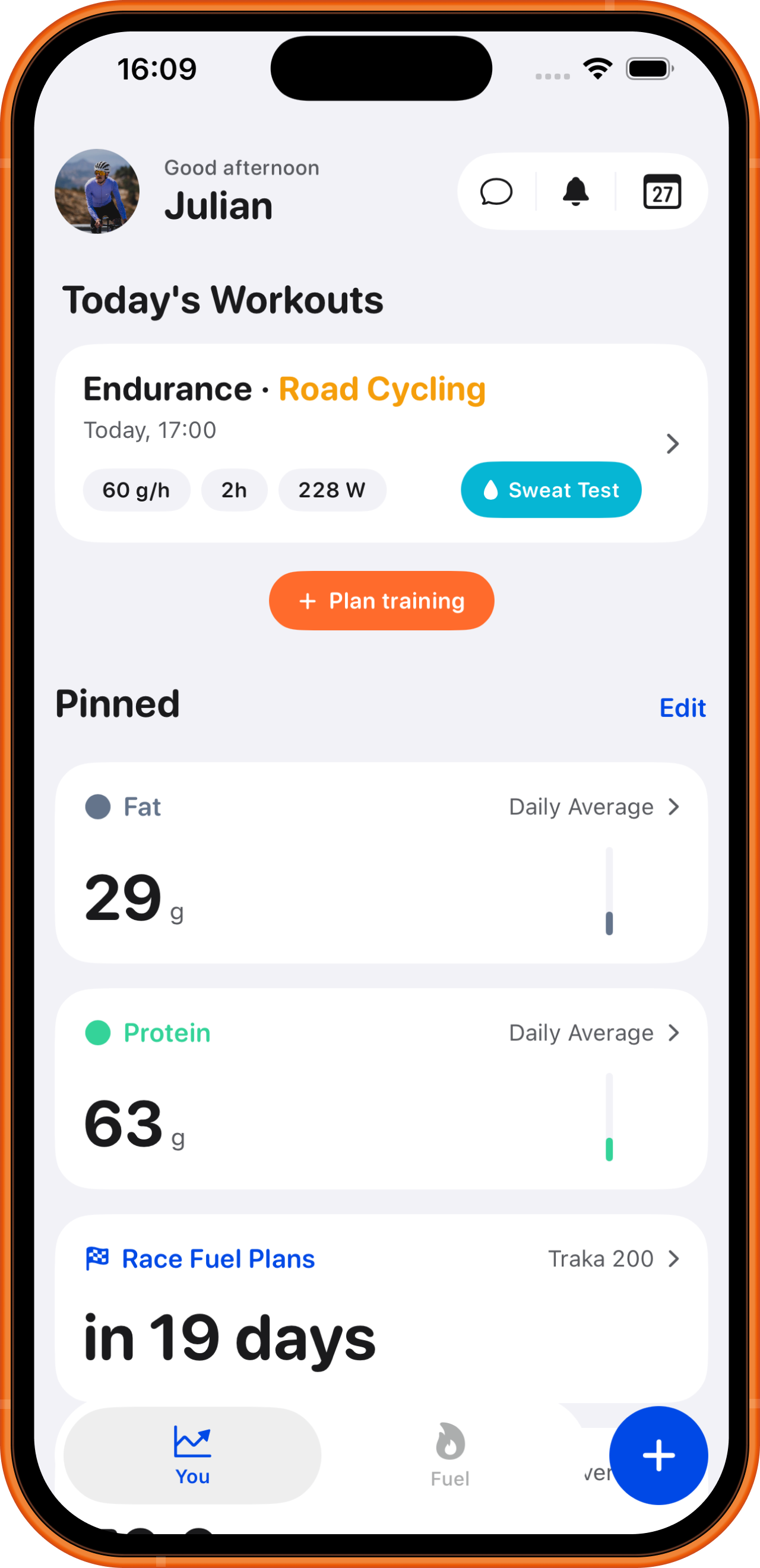
M0VE Nutrition builds that plan for you based on your weight, your sweat rate, the length of the ride, and the intensity you have planned. Connect Strava or Intervals.icu and the targets adjust to whatever you actually ride. Free 14-day trial if you want to try it for your next gran fondo or sportive.
Put this into practice
MOVE applies these principles automatically, personalised to your sport, weight and training load.
Download M0VE