Most nutrition apps treat female athletes the same as men. You enter your weight, your goal, your training load — and out comes a fixed daily target. Same calories Monday through Sunday, same macros every week, regardless of where you are in your cycle.
The problem is that your biology does not work that way. Your hormones shift across a predictable four-phase cycle. Those shifts change your resting metabolic rate, your carbohydrate efficiency, your protein requirements, and your hunger levels in ways that are well documented in the research. Ignoring them does not make them disappear — it just means your nutrition is mismatched to your body for a significant portion of every month.
This article covers what the research shows, what actually changes across each phase, and why getting this right matters for performance and not just wellbeing.
The hormonal basis
Your menstrual cycle is governed by two primary hormones: oestrogen and progesterone. Both fluctuate significantly across the cycle, and both have direct effects on metabolism.
Oestrogen rises sharply in the follicular phase — the two weeks leading up to ovulation. It increases insulin sensitivity, meaning your body becomes more efficient at pulling glucose from the bloodstream and storing it as glycogen. This is the phase where carbohydrate-based fuelling tends to work best. Performance peaks here for many athletes.
After ovulation, progesterone takes over. This is where things get nutritionally interesting. Progesterone drives a measurable increase in resting metabolic rate — your body burns more calories at rest. It also promotes protein catabolism, meaning your body is more likely to break down muscle tissue for energy if fuelling is insufficient. And it reduces insulin sensitivity, shifting the body slightly away from carbohydrate reliance and toward fat oxidation during lower-intensity efforts.
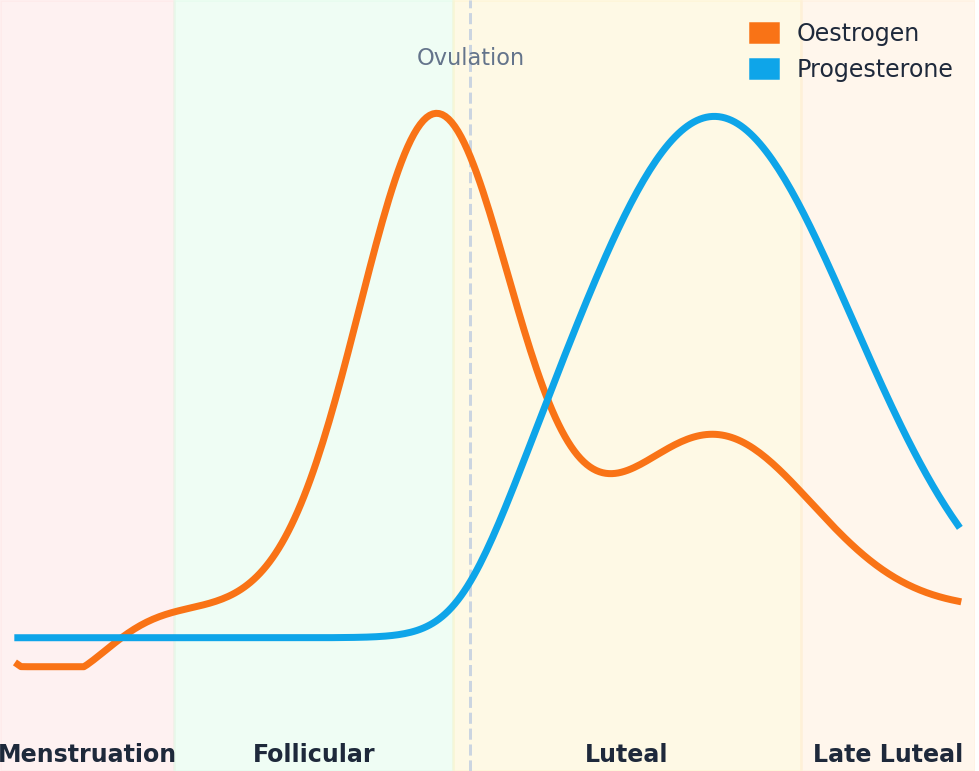
The result is that a female athlete in the luteal phase has meaningfully different nutritional requirements than she does in the follicular phase — and treating both the same leaves performance and recovery on the table.
What the research shows
"Resting metabolic rate increases by approximately 100–200 kcal per day during the luteal phase compared to the follicular phase."
This finding has been replicated consistently in the research literature. The effect is driven primarily by progesterone, which is thermogenic — it raises core body temperature slightly and increases the energy cost of basic metabolic processes.
The practical implication is straightforward: if your calorie target stays fixed across the month, you are under-fuelled during the luteal phase by roughly 100–200 kcal per day. For a training athlete, that gap compounds quickly. It shows up as unexplained fatigue, disproportionate hunger, and difficulty recovering between sessions — all symptoms that are routinely attributed to training load rather than the underlying hormonal context.
Protein requirements also shift. The progesterone-driven increase in protein catabolism means that keeping muscle mass during the luteal phase requires slightly higher protein intake than in the follicular phase, particularly around harder training sessions.
Carbohydrate efficiency follows the opposite pattern. In the follicular phase, elevated oestrogen improves glucose uptake and glycogen synthesis — carbohydrates work better. In the luteal phase, reduced insulin sensitivity means the body is less efficient at using dietary carbohydrates for fuel, shifting reliance toward fat. This does not mean cutting carbs in the luteal phase, but it does mean the timing and composition of carbohydrate intake matters more.
What this looks like phase by phase
Breaking the practical implications down across the four phases:
Menstruation — days 1 to 5 Oestrogen and progesterone are both low. Energy requirements return to baseline. Iron losses through bleeding make iron-rich food choices relevant here. The most important thing is consistent fuelling — this is not the phase to restrict. Many athletes experience increased perceived effort during this phase, which reflects real physiological cost, not weakness.
Follicular — days 6 to 13 Oestrogen climbs. Insulin sensitivity is high. Carbohydrate efficiency is at its peak. This is where most athletes will find their best training days. Performance on high-intensity work tends to be highest here. Fuelling requirements are at baseline, and the body is well set up to use what you give it.
Luteal — days 14 to approximately day 23 Progesterone rises significantly. Resting metabolic rate increases by 100–200 kcal per day. Hunger naturally increases — this is not a psychological failing but a biological signal. Calorie targets should increase to match. Protein intake is more important here to offset catabolism. Higher fat oxidation means that lower-intensity sessions can rely more on fat as fuel.
Late luteal — final 5 days before menstruation Progesterone peaks then drops sharply. The elevated calorie need continues. PMS symptoms — if present — are most common here. Magnesium supports mood regulation and is commonly depleted. B6 plays a role in serotonin synthesis. Eating enough matters here as much as at any point in the cycle.
The two most common mistakes
Eating the same every day
Fixed daily targets feel logical on paper. In practice they mean you are under-fuelled for roughly half the month. The luteal phase calorie increase is not optional — your body has already decided to spend the energy. The question is whether you are giving it what it needs or asking it to fund the deficit from muscle and recovery.
Cutting in the luteal phase
Increased luteal-phase hunger is routinely interpreted as a cue to restrict, particularly by athletes who are weight-conscious. This is one of the more counterproductive things you can do. Your resting metabolic rate is genuinely higher. Your body needs more fuel. Cutting in this phase drives up cortisol, increases muscle catabolism, impairs recovery, and typically results in the hunger returning worse. It also sets up a compensatory overeating response in the early follicular phase that wipes out any supposed deficit.
Eating more in the luteal phase is not a failure of willpower. It is the correct response to a real physiological need.
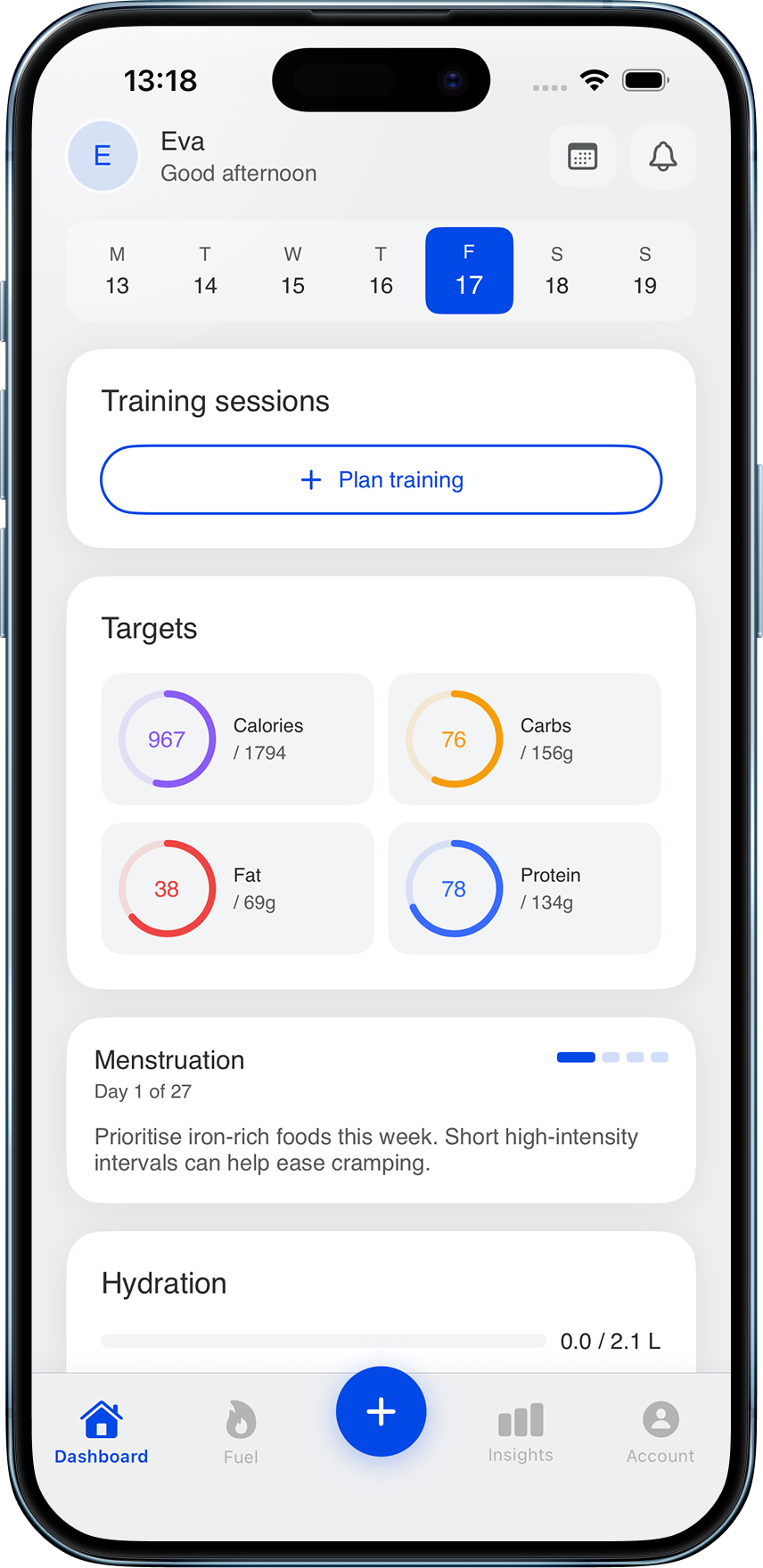
MOVE dashboard with a luteal phase card and the +130 kcal adjustment visible.
A note on hormonal contraception
Hormonal contraception — the combined pill, patch, hormonal IUD, implant, or injection — works by suppressing the natural hormonal cycle. The oestrogen and progesterone fluctuations that drive the phase differences either do not occur or are substantially blunted. The metabolic shifts described above largely do not apply.
This is not a reason to avoid hormonal contraception — it is simply context for understanding why the phase-based model does not apply in the same way. Athletes on hormonal contraception should use a standard consistent daily target rather than a phase-adjusted one.
How we track this in M0VE
MOVE reads your menstrual cycle data from Apple Health. If you track your period in the Apple Health app — or with a Garmin, Fitbit, Apple Watch, or any wearable that syncs to Health — your phase is calculated and updated automatically every day. You do not need to manually log anything.
If you do not have period data in Apple Health, you can enter your last period start date and average cycle length manually. We calculate your phase from there.
In the luteal and late luteal phases, your daily calorie target increases by 130 kcal. This is a conservative estimate based on the research — the true increase is 100–200 kcal, and we apply the lower end to avoid overcorrecting. Protein and fat targets adjust proportionally. Carbohydrate target stays consistent.
A phase card on your Dashboard shows your current phase, which day of your cycle you are on, and the active adjustment. Phase-specific nutrition notes appear based on where you are in the cycle.
Cycle tracking is enabled during onboarding for female athletes. It can also be turned on at any time from the Account tab under Cycle tracking.
Give MOVE a try today.