Can you lose weight as an endurance athlete without getting slower? Yes, if you do it slowly, do it away from your key races, and never take the deficit out of the fuel for your sessions. Most of the athletes I see go wrong the other way round: they cut hardest on the days they train hardest, feel terrible, and then wonder why the scales moved but the numbers on the bike or the track went backwards.
Let me be clear about where I stand. Lighter is not automatically faster. A cyclist going uphill, a runner over 10km and a triathlete on the run all benefit from carrying less, but only if the engine stays the same size. Lose weight the wrong way and you lose muscle, you lose training quality and, in the worst cases, you lose your health. If you are going to do it, do it properly or not at all.
Go slow, because slow works better
The best evidence we have on rate comes from a study of elite athletes in Norway. Garthe and colleagues put 24 athletes on one of two diets: one aimed to lose 0.7% of body weight a week, the other 1.4%. Both groups also did four strength sessions a week. The slower group gained more lean mass and more strength over the weight loss period. The authors' advice was simple: aim for about 0.7% of body weight a week.
The same researchers followed the athletes up a year later, and this is the honest bit most articles leave out. Body weight in both groups was back to where it started. A diet is a short project. Keeping the weight where you want it afterwards is the real work.
Here is what 0.7% a week looks like in real numbers.
Body weight0.7% a week1.4% a week (too fast)55 kgabout 0.4 kgabout 0.8 kg65 kgabout 0.45 kgabout 0.9 kg75 kgabout 0.5 kgabout 1.05 kg85 kgabout 0.6 kgabout 1.2 kg
For most endurance athletes that lands around 0.4 to 0.6 kg a week, and going slower than that is fine too. It feels slow. That is the point.
Pick your moment
Don't diet into a race. The weeks before an A race are about sharpening and recovering, and a deficit fights both. The quiet part of the year, after your season ends and before the big build starts, is where weight loss costs you least. Training is lower in intensity, there is no taper to protect, and a slightly flat session is not the end of the world.
That applies whatever you do. A marathoner in the weeks after an autumn race, a triathlete in their winter base, a swimmer between long-course seasons, a Hyrox athlete before they start their race-specific block. Same rule. Base phase yes, race block no.
Fuel the session, cut around it
This is the rule that matters most, and it is the one people break first. My view is simple: the session is where your fitness comes from, so it is the last place to save calories. A lighter body is no use if the training that built your engine got worse. So keep your session fuel exactly as it would be at maintenance.
On a long ride that means your full carbs per hour. On a long run it means the gels you would normally take. On a short, easy session you might not need anything during it at all, and that is fine. Then take the deficit from the meals that are furthest from your training: the evening snack you don't need, the second portion at dinner on a rest day.
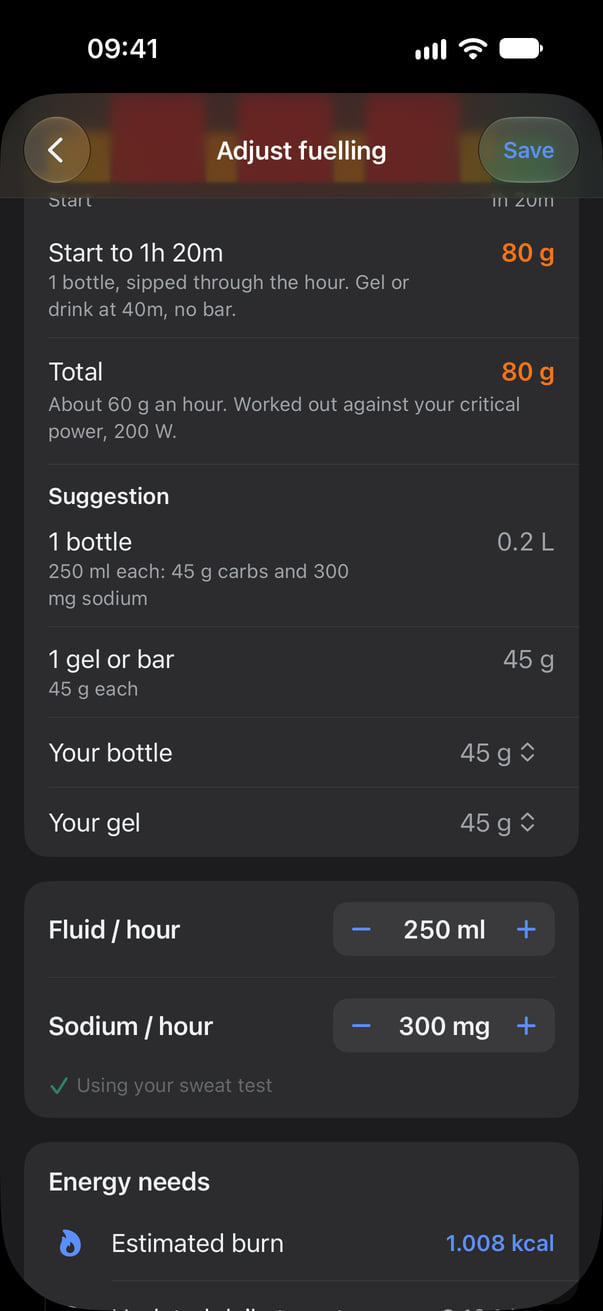
Think of it as two separate budgets. The session budget is protected. The rest of the day is where you eat a little less.
Keep protein high
When you eat less, your body is more willing to break down muscle for energy. Protein is how you push back. The International Society of Sports Nutrition suggests 1.4 to 2.0 g of protein per kg of body weight a day for most people who exercise, and says intakes of 2.3 to 3.1 g per kg may be needed to hold on to lean mass during a deficit in people who lift weights. Most of that research is on men who do strength training, so treat the top end as a ceiling, not a target.
In practice, for a 70 kg athlete that is roughly 100 to 140 g a day, spread across your meals. Keep a strength session or two in the week as well. In the Norwegian study, every athlete lifted four times a week, and it is a big part of why the slow group gained muscle while losing weight.
A simple week
DayTrainingSession fuelRest of the dayLong day3 hour ride or 2 hour runFull carbs per hourNormal meals, protein at eachHard dayIntervals or tempoFull carbs per hourNormal meals, small cut at nightEasy dayShort easy sessionUsually none neededMain place for the deficitRest dayNoneNoneSmall deficit, protein high
Nothing dramatic. No fasted punishment rides, no cutting carbs to zero, no skipping recovery meals.
Know when to stop
Eating too little for the training you do has a name: relative energy deficiency in sport, or RED-S. The early signs are easy to put down to a bad week: tiredness that does not lift, sessions that keep getting harder, getting ill more often, poor sleep, and in women, periods that change or stop. We cover it in detail in our RED-S guide.
If you notice those signs, stop the deficit and eat at maintenance until they clear. No weight target is worth a stress fracture or a lost season.
And honestly, if you are serious about changing your body weight, talk to a sports dietitian before you start. The 2016 joint position paper from the American College of Sports Medicine and the US and Canadian dietetics bodies recommends exactly that, and a good one will tell you whether you should be losing weight at all. Plenty of athletes who think they need to lose weight actually need to eat more and train better.
FAQ
How fast should an athlete lose weight? About 0.7% of body weight a week, which is roughly 0.4 to 0.6 kg for most adult endurance athletes. Faster cost the elite athletes in the Norwegian study muscle and strength.
Should I cut carbs to lose weight? Not around training. Keep your carbs before, during and after hard sessions. If you cut anywhere, cut where the day is quiet.
Can I lose weight during race season? You can, but you probably shouldn't. A deficit makes recovery harder, and the weeks before a key race are the worst time for that.
Is it fine to train fasted to burn more fat? I wouldn't. What you eat across the week decides your weight, and a hard session done with no fuel is a hard session done badly.
Will I keep the weight off? Only if you change how you eat for good. In the follow-up study, both groups were back at their starting weight a year later.
MOVE has a Lose weight goal you can set to 0.25 or 0.5 kg a week. Your session fuel is worked out first and left whole, the deficit comes from your meals, training days still raise the day's target, and it never drops below your resting energy needs.
Sources
Garthe I et al. (2011). Effect of two different weight-loss rates on body composition and strength and power-related performance in elite athletes. International Journal of Sport Nutrition and Exercise Metabolism 21(2):97-104.
Garthe I et al. (2011). Long-term effect of weight loss on body composition and performance in elite athletes.
Jäger R et al. (2017). International Society of Sports Nutrition position stand: protein and exercise. Journal of the International Society of Sports Nutrition.
Thomas DT, Erdman KA, Burke LM (2016). Position of the Academy of Nutrition and Dietetics, Dietitians of Canada, and the American College of Sports Medicine: nutrition and athletic performance. Journal of the Academy of Nutrition and Dietetics 116:501-528.
Mountjoy M et al. (2023). 2023 International Olympic Committee's (IOC) consensus statement on Relative Energy Deficiency in Sport (REDs). British Journal of Sports Medicine.