How Your Body Feels Is Data Too
Training data has never been more detailed. Power, pace, heart rate variability, sleep scores, training load, TSS — the numbers keep coming. But any coach who has worked with athletes for more than a season will tell you the same thing: the most important information often comes from a conversation, not a dashboard.
How are your legs feeling this morning? Did you fuel well yesterday? Do you actually feel ready to train?F
These questions matter. And until now, there has been no good way to capture the answers alongside the numbers.
Introducing Recovery Check-Ins
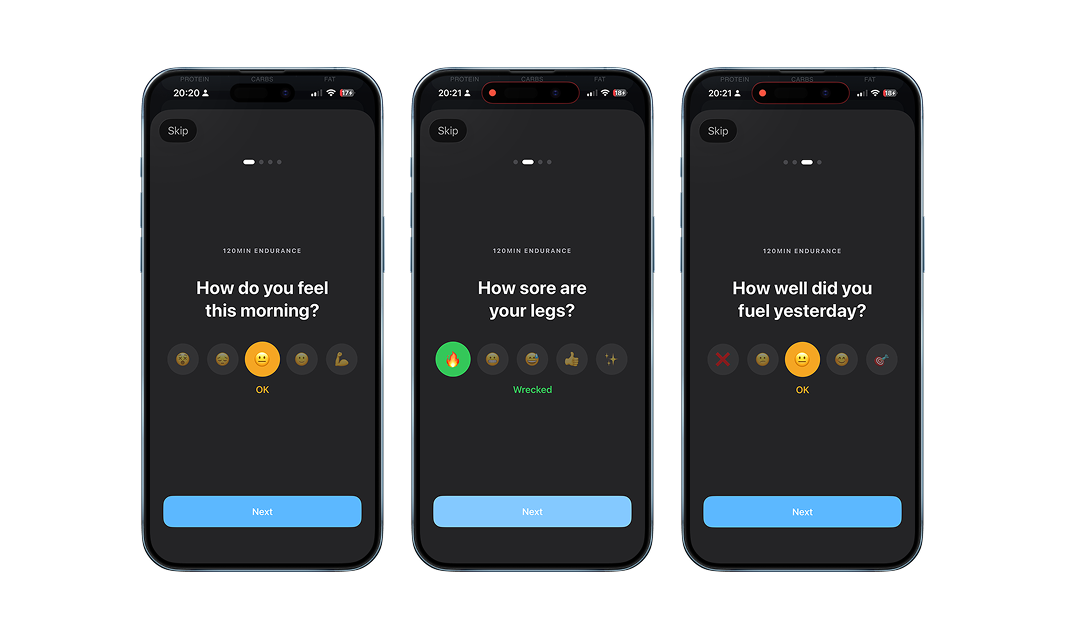
Starting now, Move Nutrition athletes on a coaching plan will receive a morning check-in prompt the day after a completed session. It takes about 20 seconds and covers three questions:
How do you feel this morning?
How sore are your legs?
How well did you fuel yesterday?
Each is rated on a five-point scale, from the honest end of the spectrum (Dead, Wrecked, Badly) through to the encouraging end (Strong, Fresh, Spot on). The three scores are combined into a single Readiness score out of 100, colour-coded from red through to green.
Why These Three Questions
Fatigue, soreness, and nutrition are the three levers that most directly affect how an athlete responds to training. A high training load with good nutrition and adequate recovery produces adaptation. The same load with poor fuelling or incomplete recovery produces breakdown.
The problem is that these things are invisible in the data. A 200 TSS week looks the same in your training log whether you ate well and slept 8 hours or survived on coffee and four hours of broken sleep. Your coach cannot see the difference unless you tell them.
Recovery Check-Ins close that gap without requiring you to write a paragraph.
What Your Coach Sees
Every check-in is immediately visible to your coach in the M0VE dashboard, under the Recovery tab in your athlete profile. They can see your readiness score for each morning, your individual ratings for feeling, legs, and fuelling, and how those trends move across the training block.
A string of low readiness scores after a hard week tells a coach something is building up before it becomes a problem. A strong readiness score the morning before a race gives them confidence heading into the day. Small signals, spotted early, make for better decisions.
It Works Both Ways
For self-coached athletes, the check-in serves as a record of how training is actually landing. It is easy to plan a training block on paper and ignore the signals your body is sending. Having a score each morning creates a simple habit of honest self-assessment.
For coached athletes, it removes the friction from communication. You do not need to remember to message your coach after a hard day. You just tap through three questions when you open the app, and the information is already there when they log in.
The Numbers Tell You What Happened. This Tells You How It Felt.
A power file can tell your coach how hard Tuesday's interval session was. A recovery check-in the following morning tells them whether your body agreed. Both pieces of information matter, and together they give a much clearer picture of where you are in a training block than either one alone.
Recovery Check-Ins are available now for all MOVE athletes linked to a coaching plan.